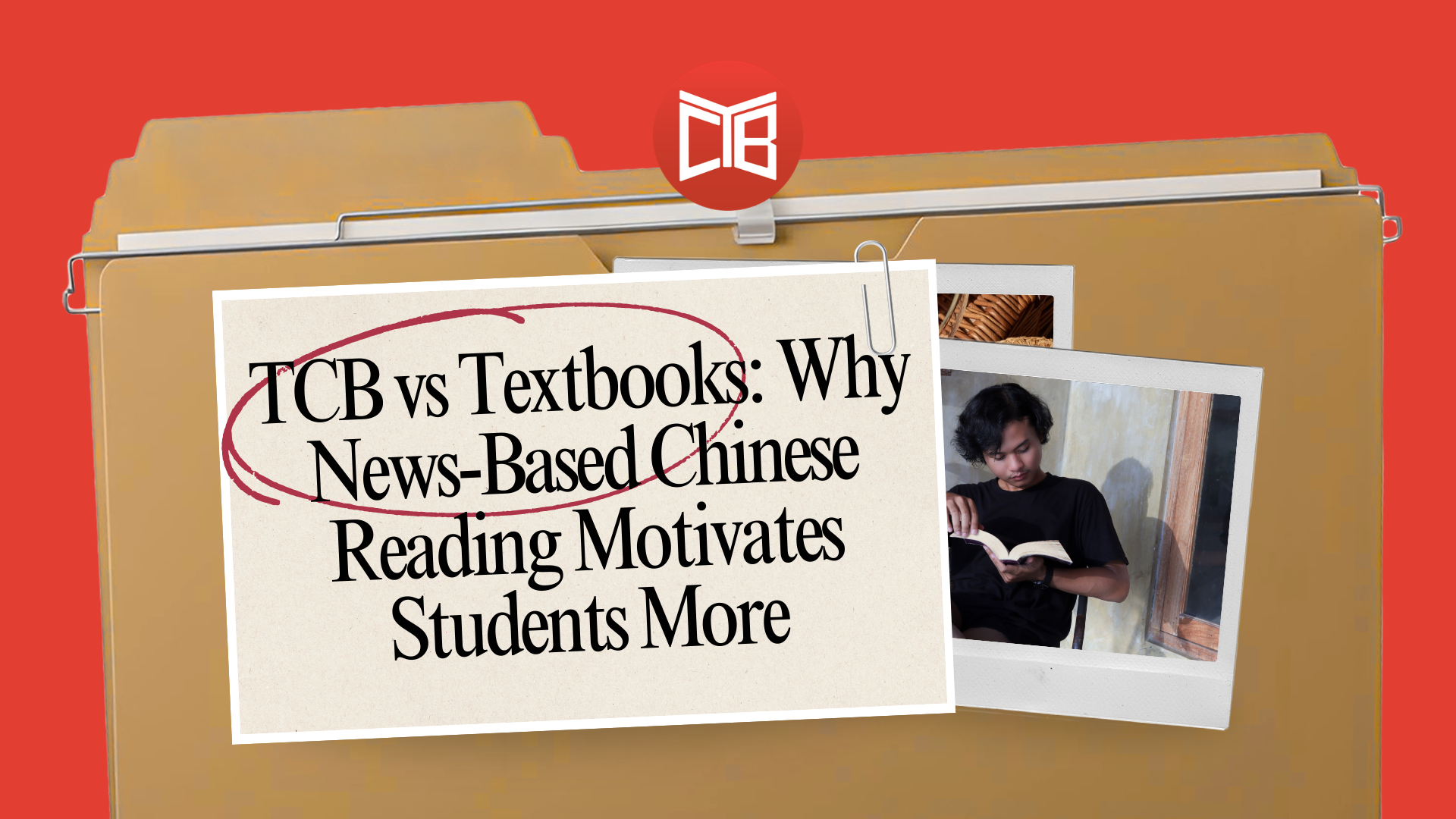
News-based Chinese reading motivates students more because it replaces artificial textbook dialogues with real stories about contemporary China—content students actually want to read. Unlike static textbooks, news-based materials offer fresh, relevant topics that connect classroom learning to students’ real-world interests, triggering intrinsic motivation.
The Chairman’s Bao (TCB) takes this further by offering news-based graded Chinese reading at seven HSK levels, solving the mixed-level classroom challenge while integrating listening practice—all with zero prep time for teachers.
When students read about topics they care about, engagement increases, retention improves, and they voluntarily read more Chinese outside class.
What you’ll learn in this article:
- Why textbooks fail to motivate today’s students
- How news-based reading builds intrinsic motivation
- Real classroom strategies from teachers using TCB
- How TCB supports diverse learners and mixed-level classrooms
- What’s included in TCB for teachers vs. schools
The Motivation Gap: Why Do Students Lose Interest in Chinese Textbooks?
Let’s be honest about something we don’t discuss enough in staff rooms: many students find Chinese textbooks boring. Not challenging. Not difficult. Just boring.
The “relevance disconnect” is a primary pain point in language acquisition.
While scripted textbook dialogues are useful for foundations, they often feel artificial and disconnected from a student’s daily life, which means that students lose interest, they stop engaging, and then, they stop retaining.
The problem with authentic Chinese reading materials such as real newspapers or social posts is that they tend to be difficult for students, who then might feel demotivated.
Kai, who teaches IB Mandarin at a leading British independent school, knows this struggle intimately.
Before discovering TCB, he spent hours searching for authentic materials his students could actually read. “I was looking at news articles, trying to get authentic materials… and I was like: ‘This would be difficult for me to read, and I have a university degree in this subject.‘”
Why Do Students Find Textbook Chinese Different from Real-World Chinese?
Textbook dialogues serve a purpose as they introduce vocabulary in controlled contexts and they model grammatical structures safely. But let’s examine what they actually ask students to read:
A: “小王,你去哪儿?”
B: “我去图书馆。”
A: “图书馆在哪儿?”
B: “就在教学楼旁边。”
(A: “Xiao Wang, where are you going? B: I am going to the library.
A: Where’s the library? B: It’s right next to the school building.”)
This dialogue is absolutely correct and useful.
But does it spark curiosity? Does it make students want to read more? Probably not.
Now compare that with a real HSK2 news-based Chinese reading headline from TCB:
“326米的“天坑书店'” (“Bookstore in 326 Meter Sinkhole Goes Viral “)
Which one would your students choose to read?
During a peer chat on the matter, a colleague noted, “Students can recite textbook dialogues about ordering food, but they struggle to understand a news clip about a bubble tea trend in Chengdu.“
This leads us to another uncomfortable truth: many textbook cultural references present an outdated image of China.
Studying history and traditional festivals is essential for understanding roots, but a curriculum whose most recent reference is from 2008 treats Chinese as a historical artifact.
Teachers deserve resources that let them teach Chinese as the living, breathing language spoken by 1.4 billion people in one of the world’s most dynamic societies.
Your students are curious about modern China and we are lucky to live in a time when we can access a sneak peek into living overseas with a single click. But for many, this authentic content feels too difficult and demotivating.
Authentic Chinese reading materials through TCB bring contemporary China into your classroom at any HSK level: today’s news, today’s culture, today’s conversations.
When students read topics that connect to their world at a level they can actually understand, they stop asking “why are we learning this” and start asking “what happens next?“
Peng-Hsu, a Mandarin Dual Language Curriculum Developer in Washington’s Bellevue School District, identifies a problem many teachers sense but can’t name: the maturity mismatch.
“A lot of times when we assign lower reading grade level material, the content becomes too boring,” he explains.
Students need simplified language, but they don’t need simplified ideas.
Peng-Hsu found that TCB solves this by offering “content still at the level of their maturity, it’s just language being modified to make shorter texts more manageable. To me it is a big perk about TCB reading.”
What Is “News-Based Chinese Reading”?
News-based Chinese reading uses real news stories, adapted for language learners, as the basis for reading practice. Students engage with simplified versions of authentic news stories, rather than fabricated dialogues about buying train tickets.
However, the benefits go far beyond “more interesting topics.”
Research in second language acquisition consistently points to the power of authentic materials. When students engage with content that matters to them, their brains release dopamine, the neurotransmitter associated with pleasure and motivation. They’re not just learning; they’re enjoying the process.
Dr. Haning Hughes, Professor of Chinese and Deputy Department Head at the United States Air Force Academy, has seen this motivational shift play out over eight years of using TCB. The platform, she says, has been instrumental in “increasing students’ motivation to read” by providing “authentic and up-to-date materials” that students actually want to engage with.
Why Does News-based Graded Chinese Reading Work?
News-based graded Chinese reading becomes a highly effective teaching powerhouse, giving learners structured exposure to current events, high-frequency vocabulary, and authentic sentence patterns while keeping difficulty under control and motivation high through real-world context and timely topics.
Consider the difference:
- Textbook mindset: “I need to learn these 20 vocabulary words for Friday’s quiz.“
- News-based mindset: “I want to understand this article about China’s new space station so I can tell my friends about it.“
One is obligation, the other is intrinsic motivation.
In addition to this, every TCB graded article includes professionally narrated audio at multiple speeds. This means students get Chinese reading and listening practice simultaneously, exactly how language works in the real world.
When was the last time you experienced language through only one channel? We read and listen constantly, often at the same time. By combining reading with listening, TCB graded news:
- Reinforce character recognition through audio support
- Build listening comprehension with authentic pronunciation
- Support different learning styles
- Prepare students for real-world Chinese where reading and listening rarely separate
Dr. Hughes specifically values TCB’s flexibility for “assigning additional listening and reading materials to students as homework,” without teachers having to create separate resources.
Do TCB HSK Graded Reading Support Diverse Learners?
Yes! Every TCB article is written at one specific HSK level, but pinyin toggles, audio narration, and teacher-controlled tasks turn that single text into multiple access points.
Everyone works at their level because you tailor the task, not the text, and this results in having the same classroom conversation afterward.
Here’s how:
- Pinyin support: For your weaker readers or beginner students, every article comes with an optional pinyin overlay. One click, and suddenly those intimidating characters become accessible. The student reads the exact same content as everyone else, but with a bridge. When they’re ready, they click again and the pinyin disappears. No separate “easy version” needed.
- Audio integration: Every article includes professional narration. Assign struggling readers to listen first, then read. Auditory learners can listen while they read. Content stays identical.
- Teacher-controlled tasks: You assign one article but tailor what each student does:
- Weaker readers: read with pinyin on, find three main ideas
- Listening practice: audio comprehension instead of reading
- Heritage learners: skim and prepare a short presentation
How Does TCB for Teachers Work?
Here are five ways to integrate it into your curriculum:
- Discussion Starters: Use a weekly “China in the News” segment to spark debate.
- Exam Support: Supplement IB, IGCSE, or A-Level themes like technology or the environment.
- Homework: Assign listening comprehension tasks using the native-speaker audio.
- Vocabulary: Build word banks from real-world contexts.
- Flipped Classroom: Have students read articles at home based on their specific level before the lesson.
You became a Chinese teacher because you love the language and want to share that passion with students. You didn’t sign up to spend every evening hunting for authentic materials and adapting them to different levels.
TCB respects your time while enhancing your teaching.
Kai, who teaches IB Mandarin at a leading British independent school, knows exactly how much time textbooks waste.
“Last year I spent many hours trying to transcribe the vocabulary list from our IB textbook… I spent probably 10 hours going through bits of it.“
After adopting TCB, everything changed. “This year, I’ve compiled an ongoing vocab list for my student based on what’s going to best fit him… I’ve already transcribed 160 vocab words for him, which is similar to the amount that I got over the entirety of last year.”
To see how other schools have successfully implemented TCB, explore our collection of case studies featuring real teachers, real classrooms, and real results.
And for step-by-step activity ideas, visit our blog: Suggested Classroom Activities – Part 1 and Part 2.
How Can TCB News-Based Chinese Articles Match Your School or Classroom?
TCB news-based Chinese articles match your school or classroom through topic coverage, level control, and curriculum-linked themes. You get graded, current texts that fit lesson goals and student ability, with structures that support planning and assessment.
Below you’ll see how this works in practice across major international programmes and daily classroom logistics.
Is TCB Aligned with IB, IGCSE, A-Level, and AP Curricula?
Yes. TCB’s content spans the themes and topics these programs require:
- IB Chinese: Identity, experiences, human ingenuity, social organization, sharing the planet. TCB covers them all through current, authentic materials.
- IGCSE Chinese: Everyday activities, personal and social life, the world around us. Each theme is richly represented in TCB’s article library.
- A-Level Chinese: Contemporary topics, cultural themes, and research-based discussions all find support through TCB’s news-based approach.
- AP Chinese: The course’s emphasis on authentic materials and real-world topics aligns perfectly with TCB’s core missio
TCB graded news doesn’t replace your curriculum, it enhances it with materials your students actually want to read.
Flexible Access for Institutions: Introducing the TCB Subscription for Schools
Individual teacher accounts are great, but schools deserve something more powerful. The TCB for schools institutional subscription offers:
- Teacher dashboards to monitor student progress across classes
- Student progress tracking with detailed analytics
- Easy rostering through integration with your school’s systems
- Whole-school access for every Chinese language student and teacher
- Administrative controls for department heads and coordinators
No more sharing passwords and no more wondering whether students are actually reading. Just a seamless, professional solution for modern Chinese language departments.
Explore our flexible school subscription plans to bring TCB graded news to your department. If you’re new to the platform, you can also get quick answers to your questions in our new teacher FAQ video series.
Frequently Asked Questions
Why does news-based graded Chinese reading motivate students more?
It replaces artificial dialogues with real-world topics like technology and culture, triggering intrinsic motivation. By using HSK graded reading, TCB ensures the content matches a student’s maturity level without being linguistically overwhelming. This transforms Chinese from an academic hurdle into a tool for real-world discovery.
How can I use news-based Chinese reading with students at different HSK levels in the same class?
TCB’s leveling system (HSK 1-6+) allows a single news topic to be rewritten at various difficulties. This ensures that the entire class stays on the same topic while each student engages with content suited to their specific ability.
Are TCB’s articles suitable for exam preparation like IB or A-Level Chinese?
Yes. The themes covered in TCB news-based Chinese reading materials range from global issues to traditional culture and directly support the thematic requirements of major international exams, providing authentic material for both discussion and writing practice.
What’s included in a TCB for teachers and schools subscription that’s different from an individual plan?
An individual account is for one person (teacher, student, or tutor) with full access to articles, audio, and exercises. A TCB for schools institutional subscription is designed for whole departments. It includes individual teacher accounts for every instructor, unlimited student accounts, teacher dashboards, detailed analytics, easy rostering, and administrative oversight for department heads. Visit our institutional subscription page for details.
Author:

Fabia Parodi
Fascinated by foreign languages and cultures, Fabia Parodi was determined to be a polyglot since she was a child. Fluent in Italian, English, French and Spanish and competent in Mandarin Chinese, Fabia is an experienced language teacher, translator and multicultural marketing specialist.
When in class, she always make sure to include graded and authentic materials in her lessons to expose students to foreign cultures and to introduce a more natural use of the language they are learning. The two things she loves more than languages are travelling and exchanging stories with people from all over the world.