How Can Teachers Build a Full Week of Chinese Lessons From a Single TCB Article?
One highly effective way is through a five-day backward design framework that turns one news article into a complete, high-engagement teaching unit. Instead of spending endless hours on Chinese lesson planning, you can use this systematic method to build a cohesive week of lessons ideal for both General and Business Chinese courses.
- Day 1: Gist and vocabulary.
- Day 2: Grammar and guided reading.
- Day 3: Speaking and interaction.
- Day 4: Writing and output.
- Day 5: Assessment and culture.
All activities are ready to use or easily adapted for mixed–level classes using authentic Chinese materials for teachers.
Why Use a Single Article for a Whole Week?
Researchers found that learners require several exposures to fundamental vocabulary and grammatical patterns in different settings to acquire them. A weekly methodical unpacking of a rich article gives spiral exposure and engages students with real-world knowledge.
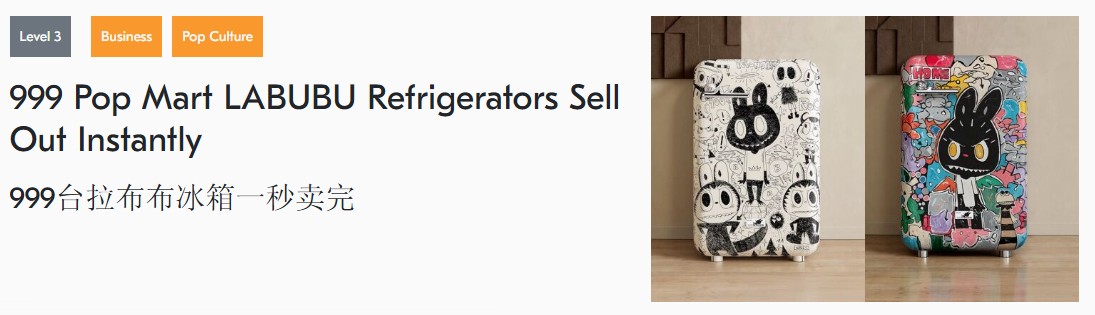
In this guide, I’ll walk you through a 5–day backward design framework using a real TCB article: “999 Pop Mart LABUBU Refrigerators Sell Out Instantly” – 999台拉布布冰箱一秒卖完
This content is perfect for intermediate learners and suitable for both General Chinese and Business Chinese courses, as it’s recent, culturally relevant, and packed with teachable language points. I’ll show you exactly how to use TCB’s built-in features to save hours of Chinese lesson planning.in features to save hours of Chinese lesson planning.
If you also teach Chinese for HSK, I’d highly recommend reading How TCB Reading Materials Accelerate HSK Progress
Where Should I Start Building My Chinese Lessons?
Before you start planning, you should choose the right TCB article. What TCB offers:
- 9,500+ news-based lessons published daily, graded by HSK level (1–7)
- Built–in audio (native speaker, not machine), comprehension questions, grammar explanations, and character writing practice
Let’s see how TCB LABUBU article checks all the boxes:
| Criterion | LABUBU article check |
| HSK level | HSK 3: real news adapted to HSK 3, ideal for intermediate learners |
| Topic relevance | Pop culture + consumer behaviour = highly engaging and suitable for both general Chinese and Business Chinese |
| Rich vocabulary | 18 keywords (e.g., 冰箱, 秒, 玩具, 决定, 值得) |
| Clear grammar patterns | 一…就…, 值得, 就是, 这么 + Adj., 所有…, 可是… |
| Cultural hook | Limited–edition hype, resale market, brand psychology |
This article passes all checks!
How Does Backward Design Work With One TCB Article?
Professor Xiaohong Wen (2015) introduced backward design to the Chinese as a Second Language community: teachers start by defining desired learning outcomes, then work backward to daily tasks and assessments.
Let’s apply this to our LABUBU article:
Identify desired results
- Language: 8–10 vocabulary items, 4 grammar patterns, reading strategy (scanning for numbers/facts)
- Content: Students can describe the event, express an opinion on whether it’s “worth it”, and compare limited–edition culture in China vs. their own country.
Determine assessment evidence
- Formative: daily exit tickets, speaking tasks, grammar drills
- Summative: end–of–week group presentation + cultural discussion
Plan learning experiences day by day → see below with a daily lesson plan of 50 min each.
For ready–to–use Chinese classroom activities, check out TCB Suggested Classroom Activities – Chinese Part 1.
Day 1: Gist, Prediction and Core Vocabulary Extraction
Lesson objective: Students will be able to predict article content from headline/image, identify the main idea after a first reading, and extract 8–10 key vocabulary items.
| Time | Activity | Details |
| 10 min | Warm–up / Prediction | Show only the headline + image. Ask: what is the article about? Why would people buy this fridge? |
| 10 min | First reading (gist) | Students read silently. Task: underline 5 unknown words (don’t look up yet). |
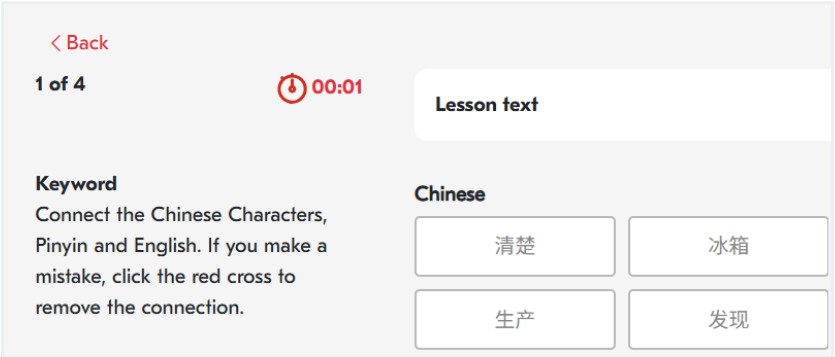
| 20 min | Vocabulary extraction | Use TCB’s keyword list and combine with a handout: word, pinyin, simple definition, example sentence from article. |
| 10 min | Exit ticket | “Write one sentence summarizing the article in your own words.” |
Differentiation: Lower students receive a pre–filled table with 6 keywords; higher students must add 2 more keywords they discovered.
Day 2: Grammar and Guided Reading
TCB resources used: Grammar fill–in–the–blanks + “Complete the sentence” (from Reading exercises)
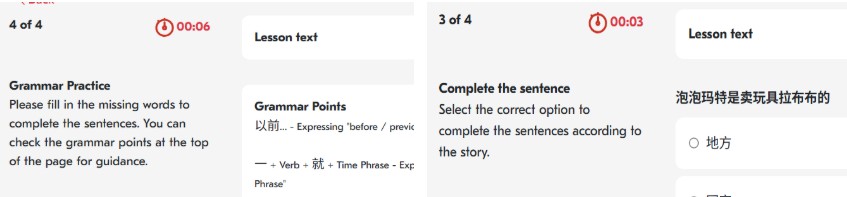
Lesson objective: Students will become familiar with new grammar patterns using TCB’s grammar list, and apply them in guided reading and fill-in-the-blank exercises.
| Time | Activity | Details |
| 15 min | Guided discovery | Put 2–3 article examples for each pattern on the board. Pairs deduce the rule, then teacher clarifies. |
| 20 min | Guided reading + TCB comprehension | Use TCB’s “Complete the sentence” and multiple–choice questions as a class or pair activity. Add inferential questions: “为什么有人愿意花9万多元买这个冰箱?” |
| 10 min | Grammar fill–in–the–blanks | Students complete TCB’s grammar exercise. |
| 5 min | Exit ticket | “Write one sentence using 值得 and one sentence using 一…就…” |
Homework: Assign TCB listening True/False + Correct the Sentence (students listen to the audio at home).
Day 3: Speaking and Interactive Communication
TCB resources used: Multiple–choice Q&A as a quick warm–up check (from Reading Exercises).
Lesson objective: Students will use article–related vocabulary and grammar in interactive spoken tasks such as role–play, hot seat, or mini–debate.
| Time | Activity | Description |
| 15 min | Role–play:
Buyer vs. Reseller |
Pair A: customer who wants the fridge. Pair B: Taobao reseller selling for 90,000 RMB. Must include key vocabulary. |
| 15 min | Hot Seat | One student plays a “superfan” who bought the fridge for 5999 RMB. Class asks questions: “你为什么要
买?” “你打算放在哪里?” “你觉得以后会便宜吗?” |
| 15 min | Mini–debate | “Pop Mart should produce more LABUBU fridges.” Group A (agree), Group B (disagree). |
Differentiation: Provide sentence starters for lower students: “我同意 / 不同意, 因为…” “如果我是…, 我会…”
For more speaking ideas, see How to Teach Modern Chinese Culture With Graded News.
Day 4: Writing and Creative Output
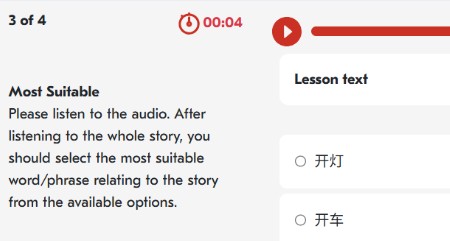
TCB resources used: Listening warm–up (Most Suitable + Fill in Blanks, both from Listening Exercises): 10–15 min at the start.
Lesson objective: Students will produce an opinion paragraph (80–120 characters) stating whether buying the LABUBU fridge is “worth it”, using at least 5 vocabulary words from Day 1 and at least 2 target grammar patterns.
| Time | Activity | Details |
| 10–15 min | Listening warm–up | Play the article audio. Students complete TCB’s “Most Suitable” (choose correct word) and “Fill in Blanks” (dictation) exercises. |
| 10 min | Model analysis | Show the last two sentences of the article: “其实,拉布布冰箱就是普通的冰箱…只是用了拉布布的牌子.” Ask: what is the author’s opinion? Do you agree? |
| 20–25 min | Opinion paragraph | Prompt: “你觉得花5999元(甚至9万元)买拉布布冰箱值得吗?为什么?” Requirements: 80–120 characters, use at least 5 vocabulary words from Day 1, use at least 2 grammar patterns (值得 / 一…就… / 就是 / 这么). |
| 5 min | Exit ticket | “One thing I learned today and one question I still have.” |
Day 5: Group Presentations and Cultural Deep Dive
By now, students have covered all language skills. Day 5 is for authentic speaking assessment and cultural reflection.
Lesson objective: Students will demonstrate cumulative understanding by delivering a group presentation on a topic related to the article, and participate in a cultural comparison discussion.
| Time | Activity | Details |
| 5 min | Warm–up and group setup | Assign groups of 4–5 (5 groups total for a class of 20). Each group chooses one presentation topic. |
| 25 min | Group presentations | Each group presents for 5 minutes. Every member must speak. Suggested topics:
品?”
心理在你的国家常见吗?” |
| 15 min | Cultural comparison discussion | Small groups discuss: “What does this article tell us about modern Chinese consumer culture?
How is it similar or different from your own country?” Then 2–3 groups share one insight with the whole class. |
| 5 min | Wrap–up and self–assessment | Students write one sentence: “One new thing I learned about Chinese culture this week.” |
If you’re interested in using AI to help generate additional tasks, 8 Ways Chinese Teachers Can Use ChatGPT to Create Lesson Plans offers practical Chinese lesson ideas.
Differentiation Strategies for Mixed Ability Chinese Classrooms
“A differentiated classroom provides different avenues to acquiring content, to processing or making sense of ideas, and to developing products so that each student can learn effectively.” — Carol Ann Tomlinson, leading researcher on differentiation
Five practical moves you can use with any TCB article and Chinese teaching materials at any level:
- Same content, different process. All students read the same article, but tasks vary: lower = literal comprehension, higher = deduction and application.
- Tiered vocabulary. Provide “must–know” (6 words), “should–know” (+4), “could–know” (+2). Assess accordingly.
- Flexible grouping. Same–ability groups for targeted instruction; mixed–ability for speaking and peer tutoring.
- Scaffolded handouts. Create 2-3 versions of worksheets.
- Extension tasks. “Challenge corner”: rewrite the article in 100 characters, create 5 quiz questions, or compare to a second TCB article.
Your Turn to Build a Week of Chinese Lessons Using One TCB Article
You’ve seen a complete 5–day framework built from one TCB article, including differentiation strategies, backward design, and how to use TCB’s built–in Chinese reading activities and listening exercises.
Now it’s your turn:
- Choose one TCB article.
- Follow the 5–day backward design framework used for our LABUBU lesson plan.
- Adapt for your level using the differentiation guide.
- Save hours of lesson planning time and give your students authentic, engaging Chinese learning experiences.
This demonstration uses a premium TCB article as an example. The full power of TCB for teachers unlocks with an institutional subscription:
- Access to 9,500+ lessons (HSK 1–6+), with 1+ new article daily
- Teacher dashboard to assign Chinese homework materials and track completion, as detailed in How to Assign Chinese Reading Homework with TCB’s Portal
- Built–in assessments (reading, listening, grammar, vocabulary)
- Student progress reporting: ideal for curriculum coordinators and department heads
Ready to access 9,500+ articles and a full teacher dashboard? Explore TCB for schools. Already have a subscription? Watch our teacher FAQ videos for more tips.
FAQ
Do I need a premium subscription to use TCB articles for weekly lesson planning?
No, a single freemium article can generate a week of lessons as well. However, a subscription unlocks full search, filtering, teacher dashboard, homework assignment features, and access to the entire library of 9,500+ lessons.
Can I use this five day framework for all levels, from beginners to AP Chinese?
Yes. The same backward–design logic applies at any level, and TCB authentic Chinese materials for teachers are flexible enough for any classroom.
What if my students finish the Day 3 speaking tasks much faster than others?
Always prepare a “challenge corner” extension task for early finishers (e.g., rewrite the role play with more advanced vocabulary, prepare 3 follow–up questions). See the differentiation section for more Chinese classroom activities that keep all students engaged.
Author:

Fabia Parodi
Fascinated by foreign languages and cultures, Fabia Parodi was determined to be a polyglot since she was a child. Fluent in Italian, English, French and Spanish and competent in Mandarin Chinese, Fabia is an experienced language teacher, translator and multicultural marketing specialist.
When in class, she always make sure to include graded and authentic materials in her lessons to expose students to foreign cultures and to introduce a more natural use of the language they are learning. The two things she loves more than languages are travelling and exchanging stories with people from all over the world.