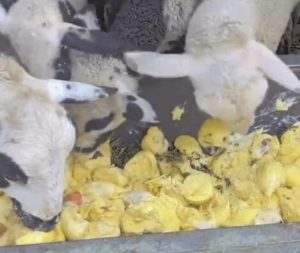
Chinese Fruit Seller Feeds Durians to Sheep SAMPLE
Chinese Fruit Seller Feeds Durians to Sheep
SAMPLE
河北水果商给羊吃榴莲
河北水果商给羊吃榴莲
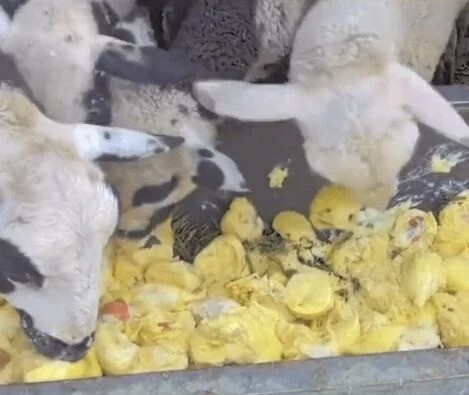


AA
AA
AA
AA
Simplified
Traditional
Pinyin
Translation


Pinyin
Keywords
水果 - shuǐguǒ - fruit
商 - shāng - commerce / merchant / dealer
羊 - yáng - sheep / goat
吃 - chī - to eat / to consume
榴莲 - liúlián - durian fruit
卖 - mài - to sell
先生 - Xiānsheng - Mister (Mr.)
买 - mǎi - to buy / to purchase
拿 - ná - to hold / to seize / to catch
家里 - jiālǐ - home / at home
星期 - xīngqī - week
次 - cì - time (i.e. number of times) / measure word for enumerated events: time
肉 - ròu - meat
好吃 - hǎochī - tasty / delicious
看 - kàn - to see / to look at / to read / to watch
Grammar
Place + 有 + Object - Expressing the existence of an object in a certain place with "Place + yǒu + Object" (similar to "there is" or "there are")
中国河北有一个卖水果的赵先生。
他说,他家里有三十多只羊。
Measure Word - Expressing the number of sth with an object specific measure word in the form of "Number + Measure Word + Noun" (if the number is one, you can omit it and use the measure word by itself)
中国河北有一个卖水果的赵先生。
Verb / Adverb / Phrase + 的 + Noun - Expressed to link a noun to a preceding verb or phrase with "Verb / Adverb / Phrase + de + Noun"
中国河北有一个卖水果的赵先生。
有时候他买的榴莲不太好,他就不卖了。
不太 + Adj. / Verb - Expressing "not very / not so…" with "bùtài + Adj. / Verb"
有时候他买的榴莲不太好,他就不卖了。
Situation + 就 + Verb / Verb Phrase - Expressing "then / and so / in that case…" with "Situation + jiù + Verb / Verb Phrase" (the action happens "as a consequence of / following on from" the situation)
有时候他买的榴莲不太好,他就不卖了。
Subject + 不 + Verb + Object - Expressing a negated verb with "Subject + bù + Verb + Object"
有时候他买的榴莲不太好,他就不卖了。
New Situation + 了 - Expressing that there is a change of state or that the action has just happened "now" with "New Situation + le"
有时候他买的榴莲不太好,他就不卖了。
他每个星期会给羊吃两三次榴莲,有两年多了。
这些 / 那些 + Noun - Expressing "these / those…" with "zhèxiē + Noun"
他拿这些榴莲给羊吃。
现在,这些羊的肉都很好吃。
很多人看了都说:“这些羊吃得太好了。”
(在)...里 - Expressing "in / inside…" with "(zài)...lǐ"
他说,他家里有三十多只羊。
Number + 多 - Expressing a number in excess with "Number + duō"
他说,他家里有三十多只羊。
每星期 / 每个星期 - Expressing "every week" with "měi xīngqī / měi gè xīngqī" (both portray the same meaning and are interchangeable)
他每个星期会给羊吃两三次榴莲,有两年多了。
Subject + 会 + Verb / Adverb - Expressing that sth "will" happen or that sb "will" do sth with "Subject + huì + Verb / Adverb"
他每个星期会给羊吃两三次榴莲,有两年多了。
Number 1 + Number 2 - Expressing approximation between two sequential numbers with "Number 1 + Number 2"
他每个星期会给羊吃两三次榴莲,有两年多了。
Subject + 都 + Adj. Phrase - Expressing a descriptive statement with emphasis that it applies to "all / both" of the subjects with "Subject + dōu + Adj. Phrase"
现在,这些羊的肉都很好吃。
Subject + Adverb + 好 + Sense Verb - Expressing that something offers a "good sensory experience" with "Subject + Adverb + hǎo + Sense Verb"
现在,这些羊的肉都很好吃。
Subject + 都 + Verb / Verb Phrase - Expressing "all / every" to emphasise the quantity with "Subject + dōu + Verb / Verb Phrase" (都 emphasises the quantity or frequent occurrence)
很多人看了都说:“这些羊吃得太好了。”
Verb / Verb Phrase + 了 - Expressing that an action has been completed with "Verb / Verb Phrase + le"
很多人看了都说:“这些羊吃得太好了。”
Verb / Adj. + 得 + Degree Complement - Expression links the verb or adjective with a degree complement with "Verb / Adj. + de + Degree Complement"
很多人看了都说:“这些羊吃得太好了。”
太 + Adj. (+ 了) - Expressing "too" to indicate excess with "tài + Adj. (+ le)"
很多人看了都说:“这些羊吃得太好了。”
Proper Nouns
Idioms
Ready to complete the lesson's exercises?


Complete Assignment Reading
Chinese Fruit Seller Feeds Durians to Sheep

Level 1
Loading...
Loading...
Live dictionary

 Stroke
 Write
WriteLive dictionary
StrokeWrite